I’ve always been interested in technology. And solving problems.
In recent years, with the gradual adoption of software applications in healthcare, I became interested in finding out why it was so hard for applications to share data and communicate.
That interest piqued one morning when I saw a technician installing a Raspberry Pi on top of a ventilator to collect and send data to an operating room records application.
One month later, in March 2025, I attended a practical course focused on process digitization in healthcare, by Nova School of Science & Technology, and promoted by my employer.
The goal was to pick a critical process that could be improved for efficiency, cost, and time reduction, while applying the concepts we’d previously learned, such as:
Interoperability and APIs
Redesigning workflows to eliminate bottlenecks and improve efficiency
Managing ownership and security risks
For my project, I mapped out a specialty department’s workflow. I identified six critical bottlenecks where data was manually re-entered 5 times into several systems, including paper records.
This process generated a 26-minute cycle time per procedure to enter data, compared to an optimized process taking 5 minutes.
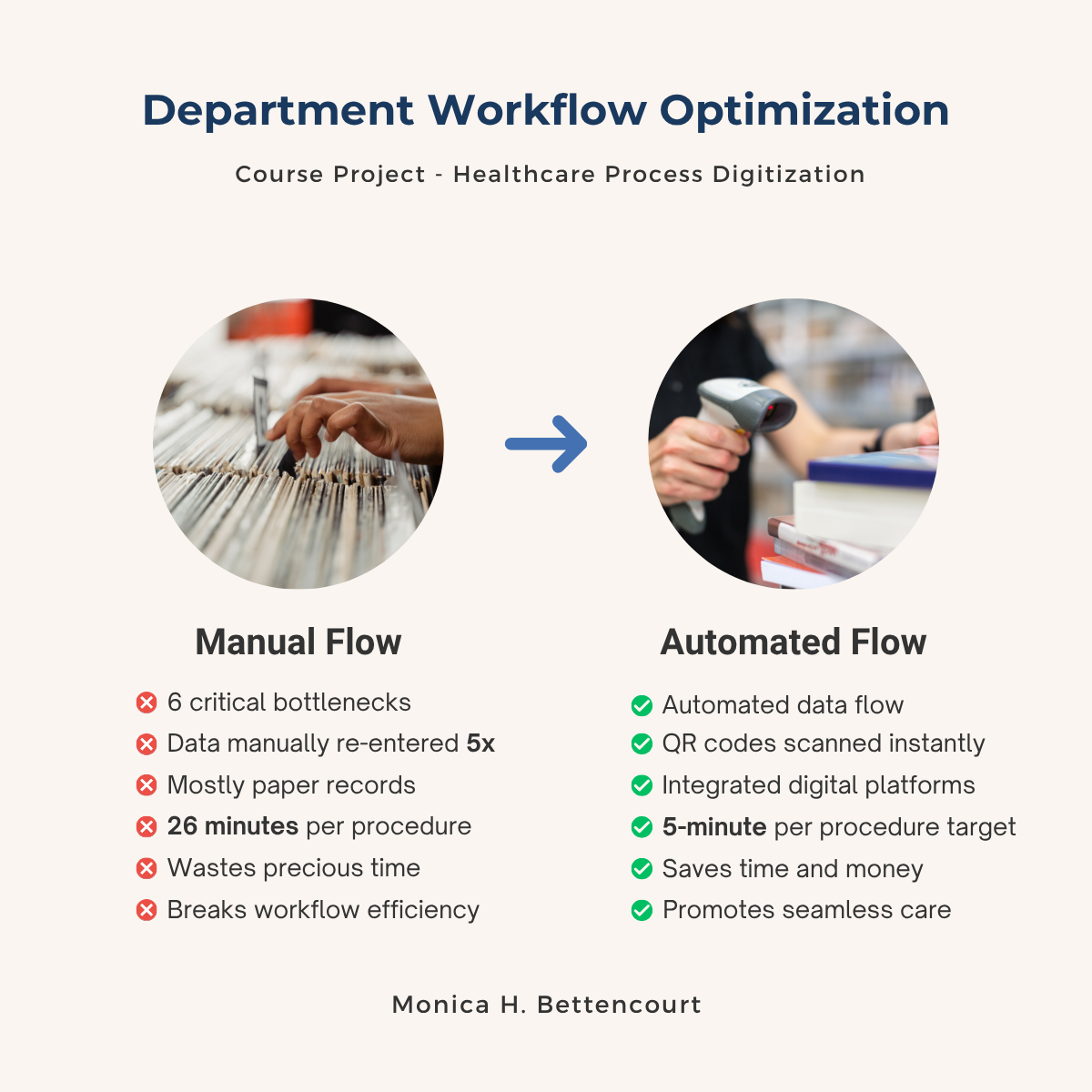
Upon completing this course, I experienced the positive effects of continuous improvement, while also understanding the need to appropriately manage people’s resistance and response to change.
During further research on API design and software development (especially application deployment), I discovered DevOps principles.
From what I’ve been learning, this experience translates into DevOps roles.
When working on a project, designing and building automated systems, improving efficiency, and reducing costs, the stakeholders (users, team members, suppliers, etc.) needs and expectations must be taken into account.
People’s resistance to change can derail a project, something I’ll keep in mind for my future endeavors.